Application and Parameter Adjustment of Bell Jar Lifting Furnace in MLCC Ceramic Capacitor Sintering
I. Core Requirements and Technical Challenges of MLCC Ceramic Capacitor Sintering
Multilayer Chip Ceramic Capacitors (MLCC) are key passive components in electronic circuits, and their sintering process directly determines the dielectric properties, mechanical strength, and reliability of the capacitors. MLCC sintering must meet three core requirements: first, temperature field uniformity to ensure synchronous densification of the multilayer ceramic dielectric and internal electrodes, avoiding cracking and delamination caused by inconsistent shrinkage; second, atmosphere controllability to inhibit oxidation in a reducing atmosphere for base metal internal electrodes (such as Ni and Cu) while preventing moisture absorption of the ceramic dielectric; third, precise control of heating and cooling rates to balance production efficiency and product yield, avoiding microdefects caused by thermal stress.
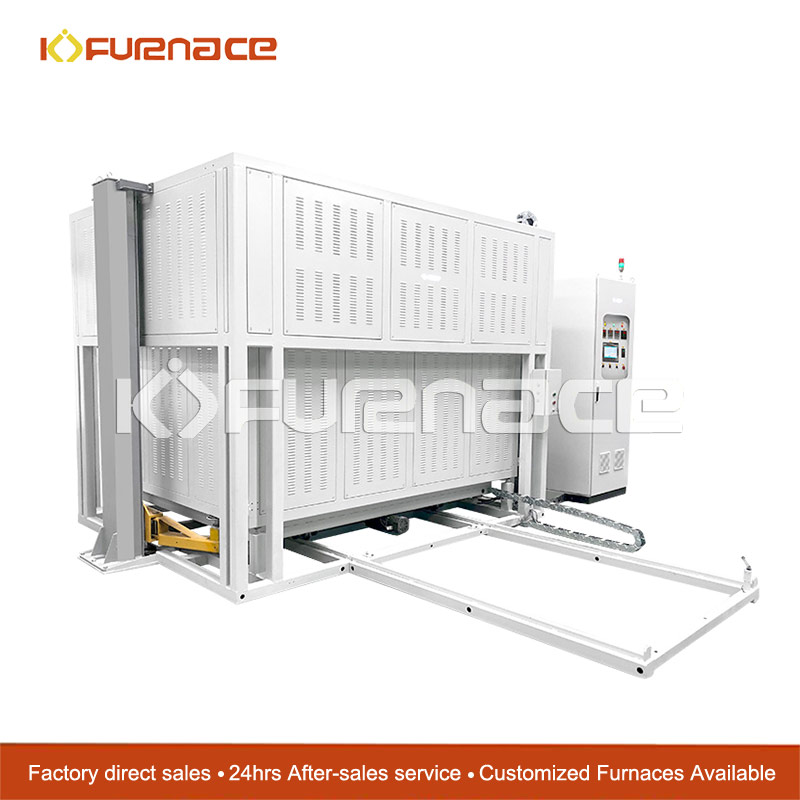
Traditional pusher furnaces and tunnel furnaces have problems such as large temperature gradients, incomplete atmosphere replacement, and insufficient process flexibility in MLCC sintering. However, bell jar lifting furnaces, with their vertical lifting structure and closed-loop control technology, have become the preferred equipment for high-end MLCC sintering.
1. Extreme Temperature Field Uniformity to Ensure Multilayer Structure Consistency
Bell jar lifting furnaces adopt a symmetrical design with top heating and bottom heat preservation. Heating elements are evenly distributed on the inner wall of the bell jar, combined with high-precision thermocouple multi-point temperature measurement and PID closed-loop control. The temperature uniformity of the effective heating zone (usually ≥φ300×400mm) in the furnace can be controlled within ±1℃. This uniform temperature field ensures that the MLCC green body heats up synchronously from the surface to the core area, avoiding differences in shrinkage rates between the ceramic dielectric and internal electrodes, and significantly reducing the defect rate of delamination and warpage. It is especially suitable for the production of ultra-thin dielectric MLCC with layers ≥100 and thickness ≤1μm.
2. Precise Atmosphere Regulation to Adapt to Diverse Internal Electrode Systems
For different internal electrode materials (Ag-Pd, Ni, Cu, etc.), bell jar lifting furnaces can realize multi-atmosphere mode switching:
Precious metal internal electrodes (Ag-Pd): Air or weakly oxidizing atmosphere is used to inhibit oxidation and volatilization of the electrode alloy;
Base metal internal electrodes (Ni, Cu): H₂-N₂ mixed reducing atmosphere is introduced to precisely control the oxygen partial pressure (10⁻⁶~10⁻¹⁰ atm), which not only prevents oxidation of the internal electrodes but also avoids excessive reduction of the ceramic dielectric leading to deterioration of dielectric properties.
At the same time, the furnace body adopts a sealed structure and inert gas replacement technology, with an atmosphere replacement efficiency of ≥99.9%, effectively reducing the impact of residual oxygen on product performance.
3. Flexible Process Curves to Adapt to Production of Different Specifications of MLCC
Bell jar lifting furnaces support custom heating, heat preservation, and cooling curves. The heating rate can be steplessly adjusted within the range of 5~20℃/min, and the cooling rate can be controlled at 3~15℃/min through air cooling/water cooling systems. For MLCC of different sizes and layers, process parameters can be flexibly adjusted:
Small-size, thin-layer MLCC: Fast heating (15~20℃/min) + short heat preservation (2~4h) + medium cooling rate (8~12℃/min) are adopted to improve production efficiency;
Large-size, thick-layer MLCC: Slow heating (5~10℃/min) + long heat preservation (6~8h) + slow cooling rate (3~5℃/min) are adopted to release internal thermal stress and ensure product integrity.
III. Key Parameter Adjustment Strategies for MLCC Sintering
1. Adjustment of Sintering Temperature and Holding Time
Core principle: Determine the reference temperature according to the MLCC ceramic dielectric formula (such as X7R, NP0) and internal electrode material, and optimize the densification degree through holding time.
Specific schemes:
NP0 dielectric MLCC (main ceramic crystal phase: MgTiO₃-CaTiO₃): Sintering temperature 950~1050℃, holding time 4~6h, ensuring complete crystallization of the dielectric and meeting the stability requirements of dielectric constant;
X7R dielectric MLCC (main ceramic crystal phase: BaTiO₃): Sintering temperature 1100~1250℃, holding time 6~8h, promoting uniform growth of BaTiO₃ grains and improving dielectric constant and temperature stability;
Base metal internal electrode (Ni) MLCC: The sintering temperature needs to be 50~100℃ lower than that of precious metal internal electrodes to avoid melting of the Ni electrode, and the holding time should be extended by 1~2h to compensate for insufficient densification at low temperatures.
2. Atmosphere Parameter Adjustment
Reducing atmosphere ratio: For Ni internal electrode MLCC, the H₂ volume fraction is controlled at 3%~8%, with N₂ as the balance gas; for Cu internal electrode MLCC, the H₂ volume fraction needs to be increased to 5%~12% to enhance reducibility and prevent Cu oxidation;
Oxygen partial pressure control: By adjusting the H₂/N₂ ratio and furnace pressure (0.1~0.3MPa), the oxygen partial pressure is stabilized below the redox equilibrium oxygen partial pressure of the internal electrode at the corresponding temperature. For example, at 1100℃, the equilibrium oxygen partial pressure corresponding to the Ni electrode is about 10⁻⁸ atm, and the oxygen partial pressure in the furnace must be ≤10⁻⁹ atm through atmosphere adjustment;
Atmosphere flow rate: Adjust the gas flow rate (usually 0.5~1.5m³/h) according to the furnace volume to ensure atmosphere uniformity while avoiding green body displacement caused by excessive gas flow.
3. Adjustment of Heating and Cooling Rates
Heating rate: Avoid thermal shock inside the green body caused by excessively fast heating. When the number of MLCC layers ≥200 or the thickness of a single dielectric layer ≤0.5μm, the heating rate should be ≤10℃/min, and further reduced to 5~8℃/min in the ceramic dielectric crystallization temperature range (such as 800~1000℃ for BaTiO₃);
Cooling rate: Control the shrinkage difference between the ceramic dielectric and internal electrodes during the cooling stage. In the range of 1000~600℃ (dielectric glass transition temperature range), the cooling rate ≤8℃/min to prevent internal stress caused by rapid solidification of the glass phase; below 600℃, the cooling rate can be appropriately increased to 10~15℃/min to shorten the production cycle.
4. Auxiliary Parameter Optimization
Furnace loading method: Use graphite or alumina sintering plates, with a spacing of ≥5mm between MLCC green bodies to avoid adhesion during sintering; for large-size MLCC, layered furnace loading can be adopted, with each layer height ≤30mm to ensure uniform temperature between upper and lower layers;
Furnace pressure: Maintain a slight positive pressure (0.12~0.15MPa) to prevent external air infiltration, and promote the circulation of the atmosphere in the furnace to improve temperature and atmosphere uniformity.
IV. Application Effect Verification
An electronic component enterprise used a bell jar lifting furnace for sintering Ni internal electrode X7R-type MLCC. By optimizing parameters: sintering temperature 1180℃, holding time 7h, H₂ volume fraction 5%, heating rate 8℃/min, cooling rate 6℃/min, the product yield increased from 82% of the traditional pusher furnace to 95%, the qualification rate of dielectric constant stability (-55℃~125℃) was ≥98%, and the mechanical strength (compressive strength ≥150MPa) was significantly better than the industry standard.
Zhengzhou KJ Technology Co., Ltd. is a high-tech enterprise specializing in the research, development and sales of heat treatment products. Our products cover muffle furnaces, tube furnaces, vacuum furnaces, atmosphere furnaces, CVD/PECVD systems, dental furnaces, bell type furnaces , trolley furnaces, etc., which are widely used in metallurgy, vacuum brazing, ceramic sintering, battery materials, metal processing , parts annealing, additive manufacturing, semiconductors, scientific intelligent instrumentation, aerospace and industrial automatic control systems and other different fields.
Please feel free to contact us.
WhatsApp: +86 18037178440
Email: web@kejiafurnace.com
 English
 简体中文
简体中文 Русский язык
 Français
 日本語
日本語 한국어
한국어 Português
 Español
 Website navigation
 Position:


 Send E-mail:web@kejiafurnace.com
 Wechat/Whatsapp: +86 18037178440
 Company Tell: +(86)18037178440





 E-mail:web@kejiafurnace.com
 Tell:+(86) 18037178440
 Whatapp:+(86) 180-3717-8440
 Address:Room 1505, Building 9, No. 26 Dongqing Street, Zhengzhou High-tech Industrial Development Zone


