Bell Furnace Sintering Guide for Large-Scale Ceramic Coatings
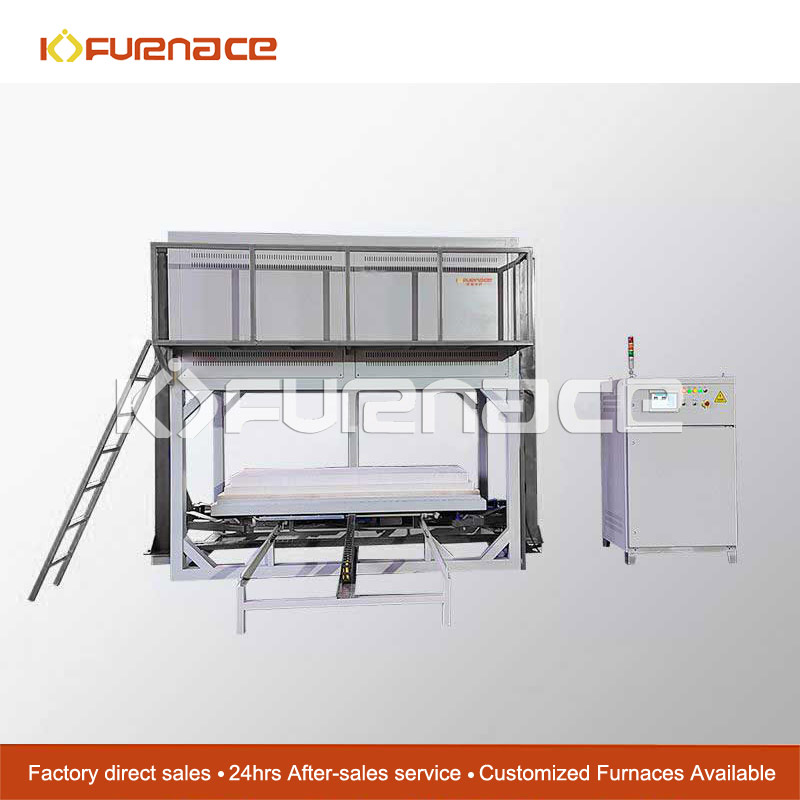
1. IntroductionCeramic coatings, featuring excellent high-temperature resistance, corrosion resistance, wear resistance, and insulation, are widely used in aerospace, machinery manufacturing, new energy, and chemical equipment. In large-scale production, sintering is the core process determining coating density, bonding strength, microstructure, and service performance. Bell-type elevating furnaces are preferred for their uniform temperature field, controllable heating/cooling rates, reliable sealing, and mass production adaptability. This article summarizes key principles, operation specifications, parameter settings, and quality control points to support industrialized stable production.
2. Sintering Principle of Bell-Type Elevating FurnacesThe sintering process promotes physical-chemical changes (particle rearrangement, densification, phase transformation, and interface bonding) of ceramic precursors via precise temperature and atmosphere control, forming uniform, high-performance coatings. Key advantages: bell-type structure enables safe loading/unloading without high-temperature workpiece movement; optimized furnace insulation and heat distribution ensure consistent heating for batch workpieces; precise control systems adapt to diverse ceramic materials (zirconia, alumina, silicon carbide, etc.).3. Sintering Operation Specifications3.1 Pre-Sintering Preparation
Equipment Inspection: Confirm furnace body integrity, clean furnace chamber, and intact heating elements (silicon carbide rods, molybdenum disilicide rods). Verify normal operation of temperature control, lifting mechanism (0.5-1m/min), sealing, and cooling systems; test limit protection.
Workpiece Pretreatment: Degrease (150-300℃, 1-2h) and dry (moisture ≤0.1%) to avoid defects. Load on corundum/graphite brackets with ≥5cm spacing between workpieces and ≥8cm from heating elements.
Atmosphere Preparation: Select air, inert gas (N₂/Ar, ≥99.99%), reducing gas (H₂/ammonia decomposition gas), or vacuum (10⁻³-10⁻⁵Pa). Purge furnace with gas for ≥15min (2-5L/min) to remove air; install leak detectors for flammable gases.
3.2 Sintering Process Control
Three-Stage Heating: Room temp-300℃ (5-8℃/min, moisture/organic removal); 300-800℃ (8-12℃/min, initial densification); 800℃-sintering temp (10-15℃/min, adjusted for materials like zirconia: 8-10℃/min). Monitor and record parameters every 20min.
Heat Preservation: Hold 2-4h (0.1-0.5mm coatings) or 4-8h (0.5-2mm coatings) with ±3℃ fluctuation. Maintain stable gas flow (inert:1-3L/min; reducing:0.5-1.5L/min); avoid mid-process adjustments.
Stepwise Cooling: Sintering temp-800℃ (8-10℃/min); 800-300℃ (10-12℃/min); 300℃-room temp (≤15℃/min, natural or assisted cooling). Break vacuum with inert gas only below 200℃.
3.3 Post-Sintering Treatment
Unloading & Testing: Unload with high-temperature fixtures below 100℃. Inspect appearance (no cracks/peeling), thickness (±0.01mm), bonding strength (≥30MPa), density (≥95% via Archimedes method), and microstructure (SEM).
Equipment Maintenance: Clean furnace chamber and heating elements; lubricate seals and lifting mechanism. Calibrate temperature control monthly; establish maintenance records.4. Core Sintering Parameter Optimization4.1 Temperature Parameters
Sintering Temp: Zirconia (1200-1400℃), alumina (1300-1500℃), silicon carbide (1600-1800℃), silicon nitride (1500-1700℃, N₂ atmosphere).
Heating/Cooling Rate: Metal substrates (5-10℃/min); ceramic/superalloy substrates (10-15℃/min); reduce for thicker coatings.
4.2 Atmosphere & Auxiliary Parameters
Inert Gas: Nitrogen (cost-effective) or argon (high purity); keep O₂ .05%.
Reducing/Vacuum Atmosphere: Use for oxidizable materials; ensure vacuum ≥10⁻⁴Pa with multiple purge cycles.
Holding Time & Loading: Avoid over-holding (grain coarsening); load 50-100kg/m³ furnace volume with layered placement (≤1/3 furnace height per layer).5. Common Problems & SolutionsCoating Cracking: Optimize heating/cooling curves, adjust sintering temp, or add transition layers.
Insufficient Bonding Strength: Extend degreasing (2-3h), increase sintering temp, or optimize precursor formula.
Low Density: Improve gas purity, enhance vacuum, or adjust temperature/holding time.
Uneven Performance: Reduce loading density, replace aging heating elements, and clean furnace thoroughly.6. ConclusionBell-type elevating furnace sintering is critical for large-scale ceramic coating production. Enterprises must optimize parameters per material/substrate, follow standardized operations, and strengthen maintenance. Future trends in intelligence (PLC control, remote monitoring) will further improve production efficiency and coating quality for high-end manufacturing demands.
Zhengzhou KJ Technology Co., Ltd. is a high-tech enterprise specializing in the research, development and sales of heat treatment products. Our products cover muffle furnaces, tube furnaces, vacuum furnaces, atmosphere furnaces, CVD/PECVD systems, dental furnaces, bell type furnaces , trolley furnaces, etc., which are widely used in metallurgy, vacuum brazing, ceramic sintering, battery materials, metal processing , parts annealing, additive manufacturing, semiconductors, scientific intelligent instrumentation, aerospace and industrial automatic control systems and other different fields.
Please feel free to contact us.
WhatsApp: +86 18037178440
Email: web@kejiafurnace.com
 English
 简体中文
简体中文 Русский язык
 Français
 日本語
日本語 한국어
한국어 Português
 Español
 Website navigation
 Position:



 Send E-mail:web@kejiafurnace.com
 Wechat/Whatsapp: +86 18037178440
 Company Tell: +(86)18037178440





 E-mail:web@kejiafurnace.com
 Tell:+(86) 18037178440
 Whatapp:+(86) 180-3717-8440
 Address:Room 1505, Building 9, No. 26 Dongqing Street, Zhengzhou High-tech Industrial Development Zone


