Pros and Cons of Rotary Furnace vs. Roller Hearth Furnace in Lithium Battery Material Production
IntroductionRotary electric heating furnaces and continuous roller hearth furnaces are the two most widely used thermal equipment in lithium battery material production, with obvious differences in production mode, temperature uniformity, adaptability to materials, and production cost. For lithium battery materials such as cathode materials, anode materials, and precursors, choosing the right furnace type directly affects product consistency, production efficiency, and economic benefits. This article focuses on the core characteristics of rotary electric furnaces and continuous roller hearth furnaces, compares their advantages and limitations in lithium battery material manufacturing, and provides clear selection guidance for process design and capacity planning.
What Is a Rotary Electric Heating Furnace?A rotary electric heating furnace is a periodic or continuous thermal treatment device that realizes material turnover and heating through the rotation of the cylinder body. Driven by a motor, the furnace tube rotates steadily, allowing materials to tumble continuously inside the cylinder. The electric heating elements arranged on the furnace wall provide uniform heat radiation, so that the material is heated evenly during the movement. It is especially suitable for powdery, granular, and small‑block lithium battery materials.
The biggest feature of the rotary electric furnace is that the material is continuously turned over during heating, which greatly improves temperature uniformity and reaction sufficiency. The equipment has a compact structure, covers a small area, and is easy to operate and maintain. It is widely used in precursor sintering, oxide calcination, carbon coating heat treatment, and other processes in the lithium battery industry.What Is a Continuous Roller Hearth Furnace?A continuous roller hearth furnace is an automatic linear thermal treatment equipment that transports materials through a roller table passing through a high‑temperature furnace chamber. Materials or saggers are placed on the roller rods and pass through preheating, heating, and cooling zones in sequence at a stable speed. The temperature of each zone is independently controlled to form a continuous and stable thermal processing line.
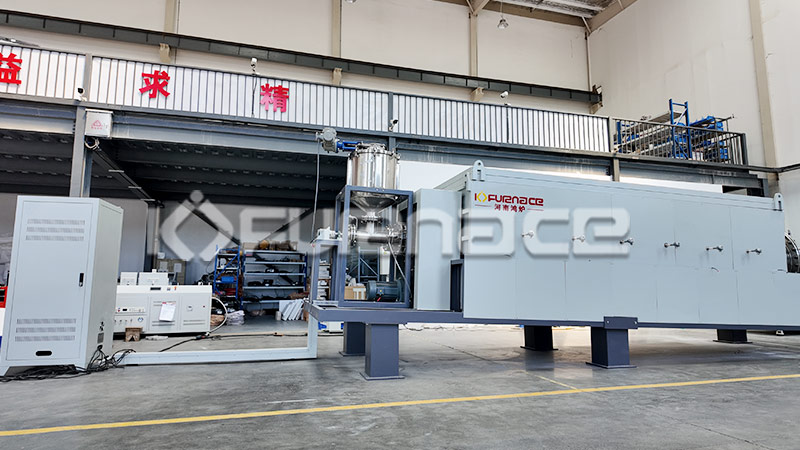
The core advantage of the roller hearth furnace lies in continuous production, stable rhythm, and high automation, which is conducive to large‑scale and standardized manufacturing. It can achieve stable output and consistent product quality, making it the preferred equipment for mass production of lithium battery anode and cathode materials.Core Differences Between Rotary Electric Furnace and Roller Hearth FurnaceWorking Principle and Material State
Rotary electric furnace relies on cylinder rotation to drive material turnover and movement, belonging to dynamic heating. Materials are in a continuous tumbling state, with good fluidity and uniform heating, less prone to agglomeration and sintering deformation.
Roller hearth furnace relies on roller transmission to achieve linear movement of materials, belonging to static or semi‑static heating. Materials are usually placed in saggers or boats, with relatively stable positions, suitable for materials sensitive to mechanical collision and wear.
Temperature Uniformity and Reaction Uniformity
Rotary electric furnace provides better temperature uniformity and material activity due to continuous tumbling. It can effectively improve the uniformity of composition, crystal structure, and particle size distribution, which is beneficial to improve the electrochemical performance of lithium battery materials.
Roller hearth furnace has good in‑plane temperature uniformity but limited heat exchange efficiency inside the material layer. Thick material layers may cause temperature gradients, affecting the consistency of internal and external reactions.
Production Mode and Capacity
Rotary electric furnace is more flexible in production and suitable for small‑batch, multi‑variety, and experimental development. It is easy to adjust formula, temperature, and retention time, but the single‑machine capacity is limited, making it difficult to meet ultra‑large‑scale mass production.
Roller hearth furnace adopts continuous automatic production and has obvious advantages in large‑scale and high‑output scenarios. Stable production rhythm, high equipment utilization rate, and low marginal cost per unit product.
Adaptability to Materials
Rotary electric furnace is more suitable for powder materials that need sufficient turnover, uniform mixing, and anti‑agglomeration. Such as precursors, ternary materials, iron phosphate, and graphite oxide.
Roller hearth furnace is more suitable for sheet, block, or sagger‑loaded materials that do not tumble. Such as anode sheets, coated substrates, and block sintered bodies.
Equipment Investment and Operation Cost
Rotary electric furnace has lower single‑equipment investment, small floor space, and simple supporting system. Suitable for initial investment control and small‑scale trial production lines.
Roller hearth furnace has higher one‑time investment, long furnace body, complex control system, and large floor space. However, the unit energy consumption and labor cost in mass production are lower.How Do They Affect Lithium Battery Material Performance?Rotary electric furnace significantly improves material uniformity and helps improve the capacity, stability, and cycle life of lithium battery materials. Uniform temperature and sufficient reaction reduce defects and impurities and improve crystal integrity.
Roller hearth furnace ensures batch stability and consistency, which is conducive to large‑scale delivery of standardized products. Stable process parameters reduce fluctuations between batches and meet the requirements of power batteries for consistency.How to Choose the Right Furnace Type?Choose a rotary electric heating furnace if you focus on material uniformity, small‑batch multi‑variety production, or R&D and testing. Prioritize it for precursor development, new material verification, small‑scale high‑performance lithium battery material production.
Choose a continuous roller hearth furnace if you focus on large‑scale mass production, stable output, and low unit cost. Prioritize it for mass production of cathode materials, anode materials, and mature lithium battery materials.SummaryRotary electric heating furnaces and continuous roller hearth furnaces have their own advantages and are applicable to different stages and scales of lithium battery material production. The rotary furnace is good at uniformity and flexibility, while the roller hearth furnace is good at continuity and scale. There is no absolute better furnace type, only the one that matches the production scale, material characteristics, and quality requirements. Reasonable selection can effectively improve product performance, reduce production costs, and enhance the competitiveness of lithium battery materials.
Zhengzhou KJ Technology Co., Ltd. is a high-tech enterprise specializing in R&D and sales of heat treatment products, including muffle furnaces, tube furnaces, vacuum furnaces and more, widely used in metallurgy, ceramic sintering, battery materials, semiconductors, aerospace and other fields.
For inquiries and customized solutions, contact us via
WhatsApp: +86 18037178440 or Email: web@kejiafurnace.com.
 English
 简体中文
简体中文 Русский язык
 Français
 日本語
日本語 한국어
한국어 Português
 Español
 Website navigation
 Position:



 Send E-mail:web@kejiafurnace.com
 Wechat/Whatsapp: +86 18037178440
 Company Tell: +(86)18037178440



 E-mail:web@kejiafurnace.com
 Tell:+(86) 18037178440
 Whatapp:+(86) 180-3717-8440
 Address:Room 1505, Building 9, No. 26 Dongqing Street, Zhengzhou High-tech Industrial Development Zone


