Low-Vacuum vs High-Vacuum CVD Systems: How Vacuum Level Affects Film Quality and Production Capacity
1. Overview of CVD Vacuum Classification and Process Mechanism1.1 Definition and Pressure Range of CVD Vacuum Grades
CVD processes are classified into low-vacuum and high-vacuum systems based on chamber pressure, forming two distinct process modes for high-yield deposition and high-purity film growth.
Chemical Vapor Deposition (CVD) relies on precise vacuum environment control to complete precursor gas pyrolysis, adsorption and film forming reactions. In industrial and laboratory standards, low-vacuum CVD is defined as the working pressure range of 1–1500 Pa, also known as conventional low-pressure CVD (LPCVD), which balances deposition efficiency and basic film uniformity. High-vacuum CVD refers to the ultra-low pressure state below 1 Pa, including ultra-high vacuum CVD (UHVCVD) working in the 10⁻³–10⁻¹ Pa range, which eliminates residual gas interference to the maximum extent and is used for high-precision and high-purity thin film preparation. The vacuum level directly determines the gas molecular mean free path, gas phase reaction mode and substrate surface deposition behavior, becoming the core parameter that restricts film quality and production capacity.
1.2 Core Mechanism of Vacuum Regulating Deposition Behavior
Vacuum level changes the gas collision frequency and molecular transport path: low vacuum enhances gas density to boost deposition rate, while high vacuum optimizes molecular linear motion to improve film uniformity and purity.
Under low-vacuum conditions, the gas density in the cavity is high, the collision probability of precursor molecules increases, the gas-phase reaction rate is fast, and the instantaneous deposition efficiency is high, which is conducive to large-capacity production. However, excessive gas collision is easy to cause uncontrollable homogeneous reaction in the gas phase, forming particle impurities and affecting film flatness. High-vacuum environment greatly increases the molecular mean free path, reduces invalid gas collision, makes precursor molecules reach the substrate surface in a linear manner, inhibits gas-phase stray reactions, and realizes accurate and uniform film growth. The two vacuum mechanisms form a natural contradiction between high yield and high precision, which runs through the entire CVD deposition process.
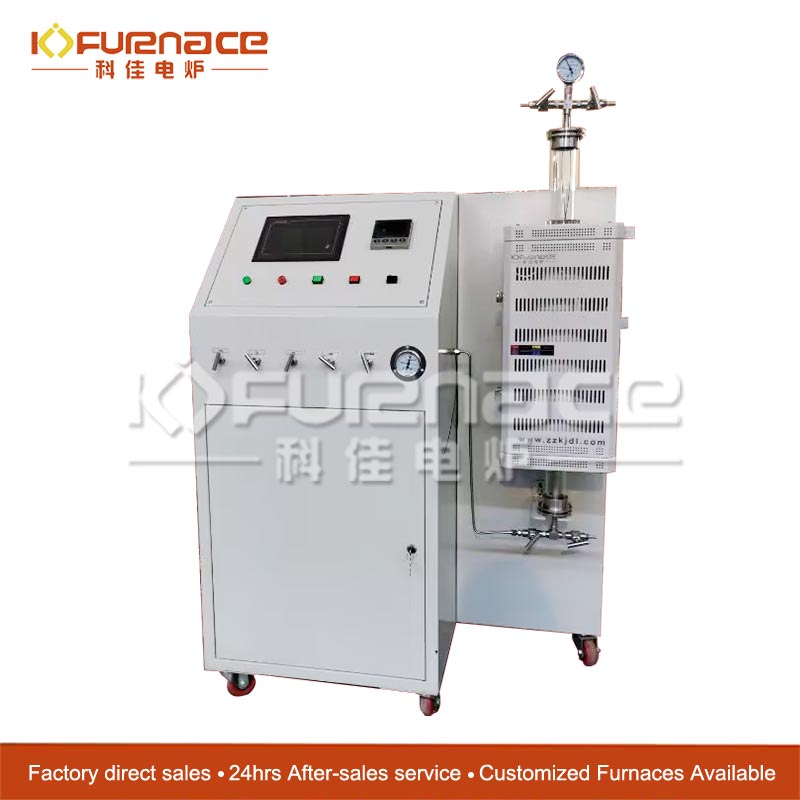
Blind vacuum level matching leads to either insufficient film purity and poor uniformity or low production efficiency and high unit cost, restricting standardized and low-cost mass production.
In actual CVD process deployment, many production lines simply pursue high vacuum for high-end films or low vacuum for high yield, ignoring the matching relationship between vacuum grade, material characteristics and process requirements. Excessively low vacuum leads to film pinholes, particle contamination and poor step coverage; excessively high vacuum causes slow deposition rate, long process cycle and low equipment utilization. Clarifying the differential influence of low and high vacuum on film quality and production capacity, and forming scenario-based vacuum selection standards can effectively balance product performance and production economy, and provide core technical basis for refined CVD process control.2. Differential Influence of Vacuum Level on CVD Thin Film Quality2.1 Film Uniformity and Step Coverage Performance
High-vacuum CVD achieves full-area uniform deposition and excellent conformal coverage; low-vacuum CVD has limited uniformity and weak coverage capability for complex micro-nano structures.
In high-vacuum environment, precursor molecules have a long mean free path, less mutual collision, and stable linear transport trajectory. The molecules can evenly reach flat substrate surfaces and deep groove sidewalls, realizing consistent film thickness deposition on complex structures such as high-aspect-ratio trenches and micro-pores, with excellent step coverage and ultra-low thickness deviation. For low-vacuum CVD, frequent gas collisions lead to uneven molecular concentration distribution, large temperature and gas flow differences in different regions of the cavity, resulting in edge-thick or center-thin film thickness deviation. In high-precision patterned deposition scenarios, low vacuum is prone to incomplete coverage and structural defects at structural corners.
2.2 Film Purity, Defect and Density Control
High-vacuum system eliminates residual oxygen and moisture to reduce film defects; low-vacuum residual gas and gas-phase stray reactions easily cause impurity doping and particle defects.
High-vacuum pumping can almost completely remove residual air, water vapor and micro-impurities in the cavity, avoiding oxidative doping and adsorption contamination during film growth. The deposited thin film has dense microstructure, few internal voids and low defect density, with stable electrical and barrier properties. Low-vacuum working conditions retain a small amount of residual gas, and high-density gas-phase reactions are easy to produce tiny polymer particles, which adhere to the film surface to form pinholes and protrusion defects. Meanwhile, residual oxygen will cause slight oxidation of the film, reducing film density, chemical stability and service reliability, which is not suitable for high-purity functional film preparation.
2.3 Film Stress and Structural Stability
High-vacuum slow deposition reduces internal stress and improves structural stability; low-vacuum rapid growth easily induces residual stress and subsequent film peeling.
High-vacuum CVD adopts a low-rate and uniform growth mode, precursor molecules are stably adsorbed and stacked on the substrate surface, the film structure grows orderly, the internal residual stress is low, and the film is not easy to crack or warp in subsequent high-temperature and chemical environments. In contrast, low-vacuum rapid deposition leads to rapid superposition of film layers, disordered molecular arrangement, and easy accumulation of internal stress. With the increase of film thickness, the stress concentration effect is amplified, resulting in film peeling, warping and failure, which seriously affects the long-term stability of devices and coatings.3. Vacuum Level Restriction Mechanism on CVD Production Capacity and Efficiency3.1 Deposition Rate and Single-Batch Production Cycle
Low-vacuum high gas density supports high-speed deposition and short cycle; high-vacuum low molecular concentration limits growth rate and reduces single-batch output.
The core advantage of low-vacuum CVD lies in efficient production. The high precursor gas density in the cavity increases the probability of molecular adsorption and reaction on the substrate surface, significantly improves the film growth rate, shortens the single-batch deposition cycle, and can realize rapid coating of large-area substrates and multi-piece batch loading. High-vacuum environment reduces the effective concentration of reactive gas, the molecular arrival rate per unit area is low, the deposition rate is significantly reduced, and the process cycle is prolonged. Although the film quality is improved, the single-day output of the equipment is greatly restricted, which is not conducive to large-scale mass production.
3.2 Equipment Utilization and Continuous Production Stability
Low-vacuum system has fast pumping speed and high startup efficiency; high-vacuum system has long pumping time and strict process waiting constraints.
Low-vacuum CVD has low requirements for vacuum pumping, short cavity evacuation time, fast pressure stabilization speed, and can realize rapid feeding and continuous switching of batches. The equipment has low standby loss and high time utilization rate, which is suitable for 24-hour continuous industrial production. High-vacuum CVD needs long-time pumping and pressure stabilization treatment before each batch of production to ensure ultra-low residual gas environment. The pumping and stabilization time accounts for a high proportion of the total process cycle, resulting in low effective working time of the equipment, frequent auxiliary standby procedures, and significantly reduced continuous production capacity.
3.3 Batch Consistency and Yield Fluctuation
Low-vacuum process is sensitive to gas flow and pressure fluctuation, with obvious batch difference; high-vacuum environment is stable and batch repeatability is excellent.
Low-vacuum deposition relies on high gas flow and dynamic pressure balance, which is easily affected by external temperature, gas source pressure and pipeline resistance. Slight parameter fluctuation will lead to changes in deposition rate and film thickness, resulting in batch quality deviation. High-vacuum system has strong environmental anti-interference ability, stable internal gas field and temperature field, fixed molecular transport and reaction rules, consistent film growth state of each batch of samples, excellent batch consistency and high product yield, which reduces rework loss caused by process fluctuation.4. Scenario-Based Selection and Full-Cycle Process Optimization Strategy4.1 Low-Vacuum CVD Priority Application Scenarios
Large-batch ordinary protective coatings, thick film deposition, industrial anti-corrosion and wear-resistant films, and cost-sensitive mass production scenarios are suitable for low-vacuum CVD.
For industrial conventional coatings, substrate protective layers, thick dielectric films and other products with low requirements for film purity and ultra-precision uniformity, low-vacuum CVD is the optimal choice. It gives full play to the advantages of high deposition efficiency, short cycle and low equipment operation threshold, meets the demand for large-scale and low-cost mass production, and balances production capacity and basic process quality. By optimizing gas flow matching and pressure stabilization parameters, the batch fluctuation of low-vacuum processes can be further reduced to improve production yield.
4.2 High-Vacuum CVD Priority Application Scenarios
Semiconductor functional films, micro-nano structural coatings, high-purity dielectric layers and high-reliability precision device films must adopt high-vacuum CVD processes.
High-end electronic devices, semiconductor chips, MEMS microstructures and optical precision coatings have extremely strict requirements on film purity, uniformity and structural stability. High-vacuum CVD can effectively eliminate impurity contamination and structural defects, realize conformal deposition of complex micro-nano structures, and prepare high-density, low-stress and high-stability functional films. Although the production efficiency is relatively low, it can meet the long-term service reliability requirements of high-precision devices and is an irreplaceable process for high-end thin film preparation.
4.3 Vacuum Grading Process Optimization and Efficiency Improvement Scheme
Adopt staged vacuum control and parameter matching optimization to realize complementary advantages of high vacuum quality and low vacuum efficiency.
For composite film preparation and medium-precision process scenarios, a staged vacuum optimization strategy can be adopted: low-vacuum rapid thickening in the initial growth stage to improve deposition efficiency, and high-vacuum precise growth in the final film forming stage to optimize surface quality and compactness. Regularly calibrate vacuum pumping speed, pressure stability and gas field uniformity, eliminate micro-leakage of the system, reduce residual gas interference. Match temperature gradient and gas flow parameters according to vacuum grade, avoid process defects caused by parameter mismatch, and maximize the comprehensive benefit of film quality and production capacity.5. Process Summary and Industry Development Prospect5.1 Core Differences and Selection Logic Summary
Low-vacuum CVD focuses on high efficiency and low cost for mass production; high-vacuum CVD focuses on high purity and high precision for high-end manufacturing. Scenario matching is the core of vacuum process selection.
The essential difference between low and high vacuum CVD lies in gas molecular motion state and reaction mode, which derives the dual differentiation of production capacity and film quality. Low vacuum brings high deposition rate and high equipment output, but has defects in uniformity, purity and stress control; high vacuum realizes ultra-high-quality film growth, but is restricted by low rate and long cycle with limited production capacity. In engineering applications, vacuum grade must be accurately matched according to product positioning, precision requirements and production batch to avoid performance redundancy or quality deficiency.
5.2 Industry Development Trend of Vacuum CVD Technology
Intelligent graded vacuum control, low-energy high-precision vacuum maintenance and efficient high-quality balanced deposition will become the mainstream development direction of CVD technology.
With the upgrading of semiconductor miniaturization, new material precision manufacturing and industrial large-scale production, CVD vacuum process will develop towards refined grading and intelligent regulation. The traditional single vacuum mode will be replaced by adaptive staged vacuum technology, which realizes low-cost and high-yield production of conventional films and high-precision preparation of functional films. The continuous optimization of vacuum system efficiency and process matching capability will further break the contradiction between film quality and production capacity, and promote the high-quality and efficient development of thin film deposition industry.
Zhengzhou Kejia Technology Co., Ltd. is a high-tech enterprise specializing in R&D and sales of heat treatment products, including muffle furnaces, tube furnaces, vacuum furnaces and more, widely used in metallurgy, ceramic sintering, battery materials, semiconductors, aerospace and other fields.
For inquiries and customized solutions, contact us via WhatsApp: +86 18037178440 or Email: web@kejiafurnace.com.
 English
 简体中文
简体中文 Русский язык
 Français
 日本語
日本語 한국어
한국어 Português
 Español
 Website navigation
 Position:


 Send E-mail:web@kejiafurnace.com
 Wechat/Whatsapp: +86 18037178440
 Company Tell: +(86)18037178440





 E-mail:web@kejiafurnace.com
 Tell:+(86) 18037178440
 Whatapp:+(86) 180-3717-8440
 Address:Room 1505, Building 9, No. 26 Dongqing Street, Zhengzhou High-tech Industrial Development Zone


